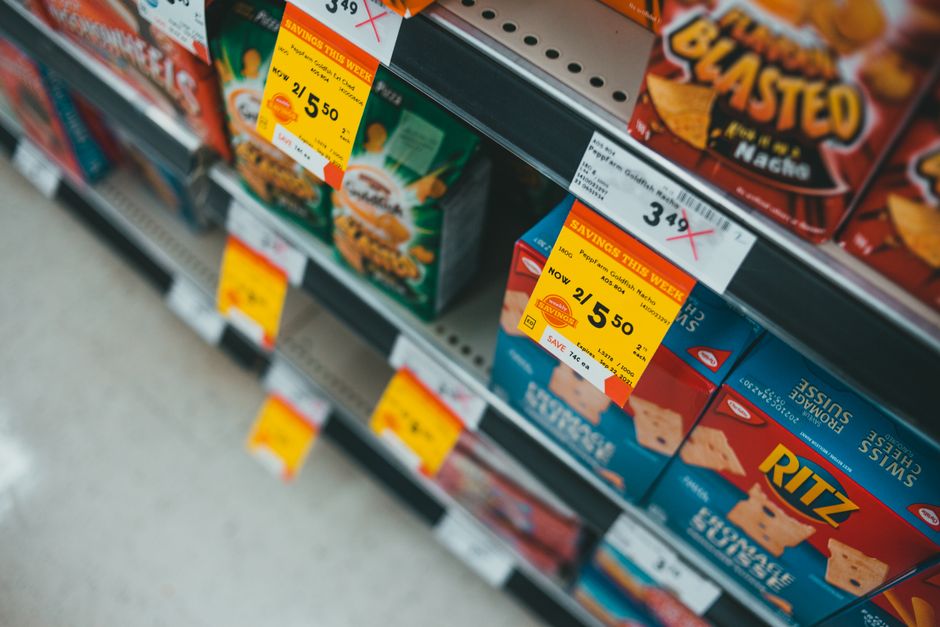
Promotional pricing is a short-term pricing strategy where a product or service is offered at a reduced price, or with added value, for a limited period. That definition sounds simple until you try to run dozens of those limited periods across hundreds of customers, products, and channels at the same time. In food and beverage, a single promotion can touch customer allowances, coupons, distributor chargebacks, retail listings, and production schedules. Spreadsheets and email approvals hold that together at small volume. They stop working the moment volume grows.
Photo by Erik Mclean on Pexels
What counts as promotional pricing
Promotional pricing is a strategic marketing approach aimed at sparking customer interest and driving sales through enticing discounts on specific products. Not every price reduction qualifies. The clearest way to separate promotional pricing from everyday pricing is the clock. Promotional pricing is specifically the time-bound subset of discounts run as a campaign, with a defined start, end, and goal.
In food and beverage operations, that shows up in a few recognizable forms:
- Temporary price reductions designed to generate quick sales during a defined window
- Added-value offers, where the price holds but the customer receives more product, more support, or extra terms
- Campaigns built to develop a long term increase in sales and demand rather than a one-time spike
- Inventory-driven discounts used to clear old or excess stock and make room for new items
The common thread is intent. A promotion is not just a lower number. It is a lower number with a purpose, a deadline, and a measurable outcome attached.
Why promotional pricing gets harder at scale
A promotion that lives in one spreadsheet and one person's memory is fragile. Ten promotions across fifty customers is a different problem entirely. The failure points are usually the same ones every time.
Manual entry multiplies every error
Every promotion that has to be typed into a pricing table, a sales order, an invoice, or a customer portal is a chance for a transcribing mistake. A discount applied to the wrong item, an end date that never got updated, a deal extended to a customer who was not part of the program. Individually these look minor. Across a large customer base, they add up to margin leakage, credit memos, and disputes that consume the time of the same people who were supposed to be planning the next campaign.
Promo consistency breaks across customers and channels
Food and beverage companies sell through a mix of distributors, retailers, foodservice accounts, and direct channels. Each of those relationships can carry its own promotional terms. Without a single source of truth, one region runs last quarter's pricing, another honors a deal that was never approved, and a third applies a discount that does not match what finance expects. Customers notice. So do auditors and account managers who have to explain the difference.

Allowances, coupons, and chargebacks: the F&B pressure points
Food and beverage partner guides consistently flag the same three pressures. Allowances have to be offered, tracked, and settled. Coupons have to be honored across systems that may not talk to each other. Chargebacks arrive after the fact and have to be validated against the original agreement. Each one is a financial commitment made at the start of a promotion and reconciled much later.
That gap between commitment and reconciliation is where promotional pricing programs break down. If the agreed terms live in one place, the shipped orders live in another, and the deduction claim arrives in a third, someone has to reconstruct the deal by hand. Multiply that by a large customer set and the process becomes a full-time job that produces no revenue.
Linking promotional pricing to demand planning
Promotions move demand. That is the point. The operational mistake is treating the pricing decision and the supply decision as separate conversations. When a promotional calendar is finalized without a view into production and inventory, two things happen. Either the promotion succeeds and the product runs short, or the promotion underperforms and the excess stock it was meant to clear stays on the shelf.
Connecting the two starts with shared data. The promotion record should carry the product, the customer or channel, the start and end dates, and the expected lift. Demand planning should be able to see that calendar before it builds a forecast, not after. Inventory planners should be able to flag a conflict before the campaign launches rather than during week two. Promotional pricing can be an effective tool for managing inventory levels, but only when the people setting the price and the people setting the production schedule are working from the same timeline.

What a repeatable promotional pricing process looks like
Consistency at scale is a process problem before it is a software problem. The sequence below is the one that holds up when volume increases.
- Define the objective for the promotion before the discount. Volume, inventory reduction, new item trial, and customer retention all lead to different terms.
- Set the start date, end date, and target audience in writing, and route the deal through a defined approval path.
- Share the approved calendar with demand planning and inventory so supply can react before launch.
- Load the terms once into the system that generates orders and invoices, rather than re-entering them per transaction.
- Match deductions, allowances, and chargebacks back to the original agreement automatically.
- Review actual results against the stated goal, then decide whether the promotion earned a repeat.
Every step that relies on a person remembering something is a step that will eventually fail. The goal is to make the process the default, so following it takes less effort than working around it.
Execution at scale: what the system has to do
Once the process is defined, the ERP or pricing system carries the load. The capabilities that matter most for food and beverage promotional pricing are not exotic. They are the basics done reliably.
- Promotion records with enforced start and end dates, so expired deals stop applying on their own
- Customer-specific and channel-specific pricing that flows into orders without manual overrides
- Automated matching of allowances, coupons, and chargebacks to the promotion that created them
- Visibility into margin impact at the promotion level, not just the invoice level
- Reporting that connects promotional activity to shipments, so demand planners see what actually happened
When those pieces are in place, promotional pricing stops being a monthly scramble and becomes a repeatable program. Finance can forecast deductions. Sales can promise terms without checking with three other people. Operations can plan production against a calendar it can trust.
Streamlined promotions management in a unified ERP
Zastro works with food and beverage businesses that have outgrown disconnected pricing spreadsheets and manual approval chains. Our case study work with a large customer set focused on streamlined promotions management, which in practice meant one system holding the promotion terms, the orders, and the reconciliation instead of three. As a NetSuite ERP consulting and implementation partner, we connect promotional pricing to the demand planning, inventory, and financial data around it. That is where consistency stops being a policy and starts being a property of the system.
Frequently Asked Questions
What is promotional pricing?
Promotional pricing is a pricing method or marketing strategy where companies lower the price of a product or service to attract consumers or meet a specific business objective. It is a short-term tactic, offered at a reduced price or with added value for a limited period. The defining feature is a defined start, end, and goal rather than a permanent change to list price. Companies using ERP systems such as NetSuite can manage promotional pricing rules more consistently across products, customers, and sales channels.
How is promotional pricing different from everyday pricing?
Promotional pricing is the time-bound subset of discounts run as a campaign. Everyday pricing sets the baseline a customer expects to pay at any time. Promotional pricing temporarily moves away from that baseline to achieve something specific, then returns. That temporary window is also what makes promotions hard to manage manually, because every deal has an expiration that someone has to enforce.
How does promotional pricing help manage inventory?
Promotional pricing can be an effective tool for managing inventory levels. Discounts help clear out old or excess stock so a business can make room for new products. The benefit depends on coordination: if demand planning sees the promotion calendar in advance, production and purchasing can align with the expected lift instead of guessing after the campaign launches. Zastro frequently works with distribution, manufacturing, and retail organizations to improve this alignment through NetSuite optimization and reporting.
Why do promotions become inconsistent as a business grows?
Inconsistency usually comes from manual entry. Each promotion has to be applied across pricing tables, orders, invoices, and customer records, and every handoff introduces a chance for error. Without one system holding the agreed terms, different regions and channels drift into different versions of the same deal, which creates disputes and margin leakage.
Where should promotional pricing data live?
Promotion terms belong in the same system that generates orders, invoices, and deductions. Keeping them in spreadsheets or separate tools forces manual reconciliation of allowances, coupons, and chargebacks later. A unified ERP lets the original agreement, the shipped order, and the resulting deduction sit in one record, so anyone reviewing the promotion sees the full picture.